Saily vs Quibity at a Glance
Prices updated November 19, 2026.
| Feature | Saily eSIM | Quibity eSIM |
|---|---|---|
| Currencies | US dollar, euro, British pound and Swiss franc | Euro, US dollar, British pound and more than 10 other currencies |
| Pay-as-you-go plans | From 1 GB to 20 GB | From 1 GB to 100 GB (depending on the destination) |
| Unlimited plans | Yes, from 5 to 30 days | Yes, from 1 to 30 days |
| Global plan | 3 Saily Ultra subscription plans (up to 365 days, up to 50 GB, valid in 121 countries) | A single Global eSIM (pay-per-use: you only pay for what you use, with no expiry, in 177 countries) |
| Daily cap in the USA | 5 GB at high speed, then up to 1 Mbps | 6 GB at high speed, then reduced speed |
| Phone number | Optional, offers a US number | Not included |
| Hotspot | Yes | Yes |
| Top-ups | Yes | Yes, on rechargeable plans |
| Cashback | 3% (in Saily credits) | 5% in account credit |
| Trustpilot | 4.7/5 | 4.7/5 |
Prices, availability and features can always change, so check the official websites. Usage caps on unlimited plans depend on the destination.
The first difference you’ll notice is the currency. Saily only offers four, which is fine if you’re in Europe but pretty limiting for travelers from the rest of the world. Quibity, on the other hand, gives you more than 15 languages and currencies on its website.
Both providers offer a huge range of plans for countries all over the world, but one difference jumps out right away: cashback. Quibity gives you 5% back on every plan, while Saily returns 3% as Saily credits.
How Saily eSIMs Work: Plans, App and Security Features
Saily is an international eSIM service from Nord Security, the company behind NordVPN.
Like any eSIM provider, Saily lets you buy a data plan for the country you’re traveling to, install the eSIM on your phone and connect to local mobile networks once you arrive.
What Plans Does Saily Offer?
Saily has two main types of packages:
Fixed-GB plans: you can choose from different amounts of data, usually from 1 GB to 20 GB, with durations that vary by destination.
Unlimited plans: available in several countries, lasting from 5 to 30 days (with top speed reduced once you’ve used a certain number of GB in a day).
Saily launched its unlimited plans fairly recently (May 7, 2025), giving heavy data users more options on the road.
Saily’s Security Features
Where Saily really stands out is probably in its extra features, especially when it comes to online security:
Ad blocking and data-saving features.
Protection against potentially malicious links while you browse.
Virtual locations that hide your real IP address and give you more privacy on foreign networks.
Credits worth 3% of what you spend.
It’s important, though, not to confuse these features with full device protection. Blocking ads and malicious links doesn’t fully replace an antivirus or a VPN, won’t protect you from every phishing attempt and doesn’t make you anonymous online.
Many international providers (Saily included) route data through servers outside Europe, where privacy laws are less strict. Quibity takes a different approach: your traffic and data only go through European servers, in line with the GDPR, which is famously one of the toughest privacy frameworks around. Saily, by contrast, states explicitly that it may store and transfer personal data worldwide, including to countries outside the European Economic Area (EEA).
Price Comparison Across Four Destinations: Turkey, the USA, Albania and Egypt
Now for the practical part: how much do Saily and Quibity eSIMs actually cost?
To keep the comparison meaningful, we used the same amount of data and the same duration for both: 1 GB for 7 days in 4 of the top destinations of 2026.
The prices below are the ones shown on each provider’s price list on November 19, 2026.
| Destination | Saily: 1 GB / 7 days | Quibity: 1 GB / 7 days | Saily: 10 GB / 30 days | Quibity: 10 GB / 30 days |
|---|---|---|---|---|
| Turkey | €3.49 | €2.50 | €13.99 | €11.20 |
| USA | €3.49 | €4.70 | €20.49 | €13.20 |
| Albania | €3.49 | €4.20 | €19.49 | €12.80 |
| Egypt | €7.99 | €3.80 | €24.39 | €24.10 |
As with every comparison in our articles (and the one you should make yourself before buying), the key is to look at the same duration and the same amount of GB, so it’s always a fair fight. For Quibity and Saily, we compared two types of plans available in all the countries we looked at, and Quibity came out cheaper almost every time. Keep in mind that card fees can always change the amount you’re actually charged.
For short trips or average data use, it’s always worth picking a plan that fits. Both providers offer 3 GB or 5 GB plans in almost every country, for example, but with different durations, as you can see in the screenshots below.
Turkey is a great example: Quibity offers anything from 1 GB all the way up to 100 GB, valid for 180 days. Flexibility is one of the big perks of choosing a Quibity plan, which aims to cover all the different connectivity needs you might have on your trips. Saily, on the other hand, tops out at 20 GB. Need more than that? You’re pretty much stuck buying an unlimited plan.
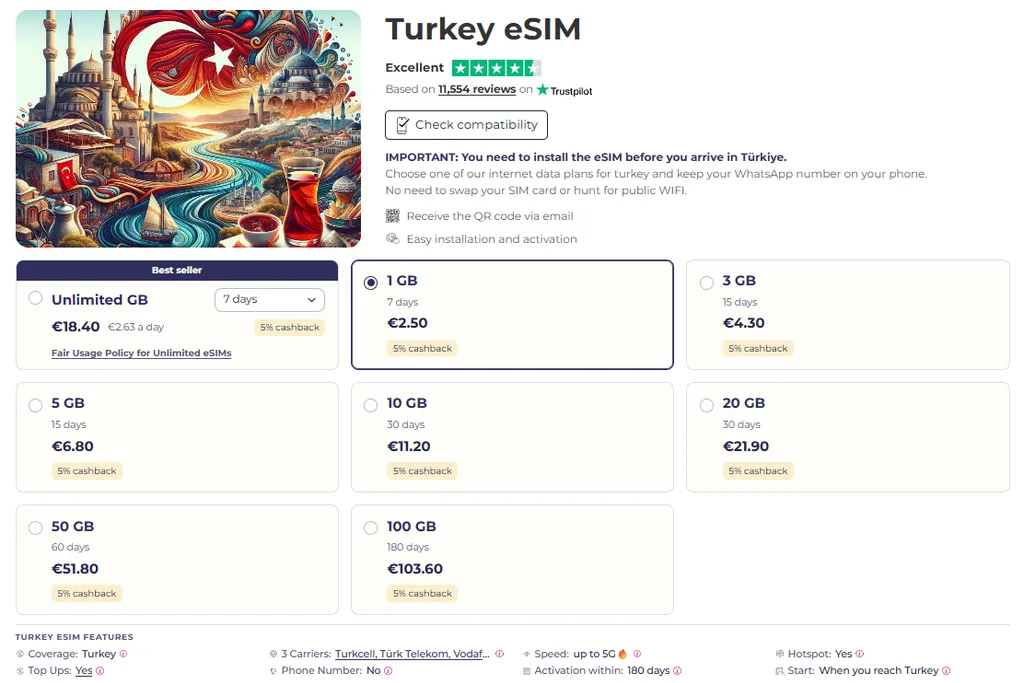
Quibity eSIM plans for Turkey as of November 19, 2026.
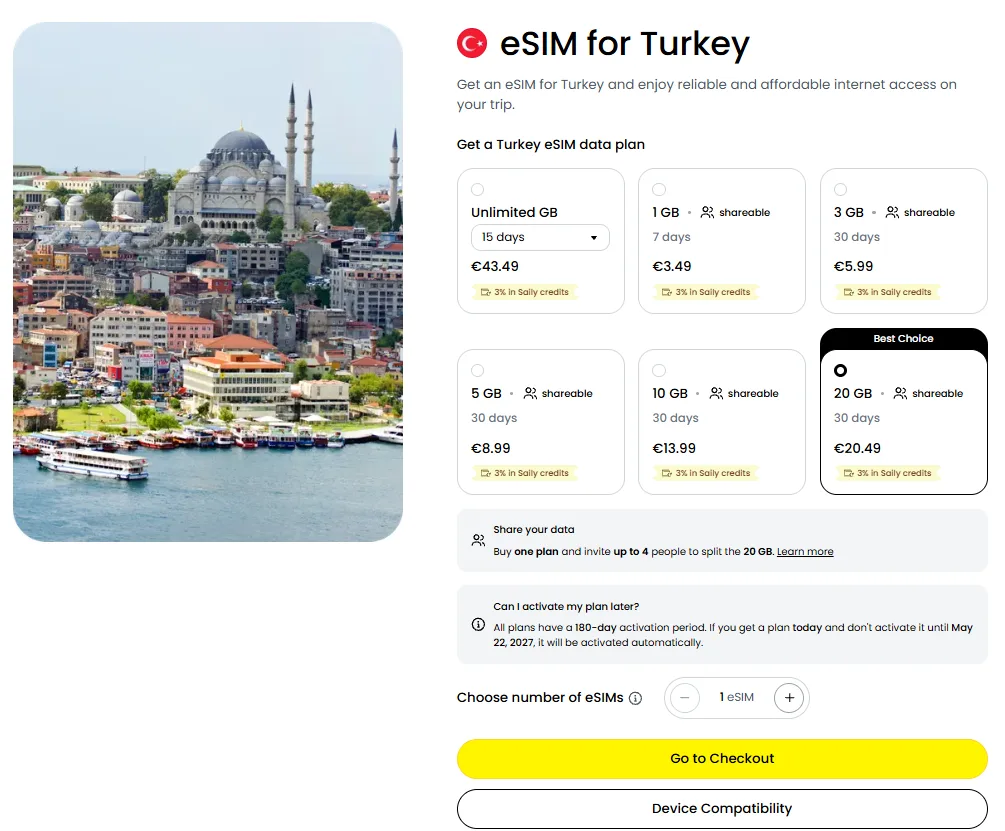
Saily eSIM plans for Turkey as of November 19, 2026.
Unlimited Plans: What “Unlimited” Really Means
This is one of the most important things to understand before you buy an eSIM.
Both Saily and Quibity offer unlimited data plans. However, both come with a daily high-speed data cap. In other words, you can keep using the internet after you’ve used up your daily allowance, but at a lower speed.
How Does It Work with Saily and Quibity?
In the United States, for example, Saily’s unlimited plan includes:
- 5 GB per day with no speed limits set by the plan.
- Unlimited data after that at up to 1 Mbps.
So once you’ve used your first 5 GB of the day, you can keep browsing, but some things will slow down. You’ll still be able to send WhatsApp messages and search the web, for example, while HD video streaming and downloading large files might be a bit of a struggle.
Quibity also applies a daily cap to its unlimited plans, but the amount of high-speed data depends on the country. Sticking with the USA:
- 6 GB per day with no speed limits set by the plan.
- Unlimited data after that at up to 1 Mbps.
The counter resets every 24 hours, starting from the first time your eSIM connects to the network. Once you go over the cap, you can keep using the connection at reduced speed until it resets.
The difference compared to Saily eSIMs comes down to quantity: in the United States, Quibity gives you 1 GB more high-speed data per day than Saily’s stated cap.
The same goes for the eSIMs in the other countries we looked at. In Albania, Egypt and Turkey, Quibity’s unlimited plans all have a higher full-speed daily cap than Saily’s (6 GB vs 3 GB, 4 GB vs 3 GB and 6 GB vs 5 GB, respectively).
If you use the internet abroad for work, video calls or sharing files, this detail can make a real difference.
Phone Number, Hotspot and Top-Ups
Beyond price, three features can really make a difference on a trip: a phone number, sharing your connection via hotspot and being able to add more data if you run out.
Saily offers an add-on:
- a US phone number for a listed price of $1.99 a month, with the option to buy call and text plans.
It’s handy if you need a number for calls or regular texts during your stay, without hunting down an extra local physical SIM. That way you’ve got both a number and an eSIM connection at your fingertips. The downside? On top of the monthly fee to keep the number active, you’ll have to buy separate packages for minutes and texts, so you’ll end up spending quite a bit more. In the end, it’s really only useful if you’re traveling in the United States. If you give this number to family or contacts outside the US, for example, anyone who calls you will pay international rates to the United States… not exactly ideal.
Quibity, on the other hand, is a data-only eSIM that works with Dual SIM. It doesn’t give you a new phone number, and you can’t make regular calls or send texts through a number linked to the eSIM. That doesn’t mean you can’t call or text anymore, let alone give up your usual number.
If your phone supports Dual SIM, you can keep your usual physical SIM on for calls and texts and simply make Quibity your main eSIM for mobile data. That way you can keep using WhatsApp with your usual number and browse through the eSIM, or choose to call and message only through messaging apps, avoiding any international roaming charges on your regular number altogether.
Hotspot and Connection Sharing
If you travel with several devices, hotspot is essential: it lets you use all of them without buying a pile of different data plans.
Both Saily and Quibity let you share your connection via hotspot, always and in every country. If you use a laptop for work or share your connection with other people, though, make sure you pick a package with enough data. On Quibity’s local and regional eSIMs, hotspot is unlimited, which means you can share every last GB of your package with another device if you want to. For unlimited data plans, the Fair Usage Policy applies.
Top-Ups
With Quibity, you can top up compatible GB plans right from your personal account.
It’s a practical fix if you bought a 5 GB package and realize mid-trip that it’s not enough… it happens! If you’d rather avoid that hassle, check out our guide to saving data on the most popular apps too.
Saily also lets you add data through its app, including automatic top-ups where the plan allows them: when your remaining data drops below a certain threshold (or runs out), the app automatically buys and activates an identical package and charges it to your saved payment method. One small catch: if a background app (like a system update or a cloud backup you forgot about) suddenly eats through your GB, Saily will immediately charge your card for a new package without asking you first.
With Quibity, you can buy simple top-ups whenever you need them, or set up an automatic top-up from your desktop account that kicks in every time your data package, while still within its validity period, drops below 500 MB. Automatic top-ups cost 20% less than manual ones.
Another point that cuts both ways: managing everything from the app, as Saily lets you do, is convenient. But if you have trouble logging into your account while traveling, you can’t easily top up from a regular web browser, which is always possible with Quibity.
Bottom line: one way or another, both providers save you from having to buy a brand-new eSIM every time you run out of data.
What the Reviews Say
Before choosing a provider for your next trip, it really helps to read genuine reviews from people who’ve actually used their eSIM plans. On Trustpilot, both brands have a score of 4.7 out of 5.
Here’s what we found in November 2026:
| Service | Trustpilot rating | Number of reviews |
|---|---|---|
| Saily eSIM | 4.7/5 | About 33,500 |
| Quibity eSIM | 4.7/5 | About 11,400 |
The numbers keep going up, but more doesn’t necessarily mean better. Quibity’s user base has traditionally been strongest in Europe, so its volumes are smaller than those of global giants like Saily. That’s exactly why such a high average from so many positive reviews is worth noting. Quibity (formerly eSIM.sm) is also a much younger brand than Saily, so it’s completely normal for it to have fewer reviews.
Recurring themes in Quibity’s reviews include how easy installation is, customer support that’s always available (in several languages) and the flexibility of the pay-as-you-go Global eSIM. On Saily’s Trustpilot profile, the most frequently mentioned strengths are the intuitive app and the handy built-in ad blocker.
Which One Should You Choose: Saily or Quibity?
So, which of the two eSIMs is worth buying?
It depends on what you’re looking for. Neither service is better across the board, but there are situations where one of them has pros that fit your needs better.
Choose Quibity If:
- You want a generally lower price across many destinations and durations: as we’ve seen, Quibity’s prices are more competitive, especially for popular destinations like Turkey and Egypt.
- You want a simple eSIM for browsing that’s quick to activate: if what you mainly need is internet, maps, messaging and hotspot, without any extras.
- You travel a lot but don’t want to buy more data than you need: with the pay-as-you-go Global eSIM, you top up a balance that never expires and only pay for the MB you actually use, so you don’t waste prepaid GB on short trips (or lots of layovers).
- You want to earn more cashback: Quibity gives you 5% back on purchases, compared to Saily’s 3% in credits.
- Privacy is a priority for you: unlike providers that route traffic through global servers outside the EU, Quibity only sends your data through European infrastructure, in full compliance with the GDPR.
- You want full control over your spending, with no automatic charges and web-based management: no automatic top-ups means no surprise charges on your card, and you can add small extra amounts (like 1 GB for the last few days) and manage everything from any browser, without always relying on the app.
- You want a simple eSIM for browsing or working over hotspot: Quibity gives you a direct connection with no filters in between. This avoids potential conflicts with company VPNs or laptop security systems, issues that can crop up with Saily if its DNS filters or virtual location feature are left on.
Choose Saily If:
- You’re interested in extra security features: ad blocking, protection from malicious links and virtual locations give you an extra layer of protection compared to a plain connection. If you already have antivirus on your phone, though, you might not care much about this extra.
- You need a US phone number: the US (+1) number option is a real plus if you need regular calls and texts to and from North America.
- You want the peace of mind of a subscription: with Saily’s Ultra plan, you’re connected in 121 countries with a single eSIM. Just pick a plan between 10 and 30 GB a month and start your subscription.
So here’s our final tip: if you’ve already picked the destination for your next trip and you’re still on the fence, the best way to choose is to compare plans directly on each destination’s official page.
You can start with the four destinations we’ve covered:
Frequently Asked Questions
Is Saily reliable?
Yes, Saily is reliable: it’s backed by Nord Security, the company that also develops NordVPN. On Trustpilot, it has a rating of 4.7 out of 5, based on more than 33,000 reviews. That’s a very good sign, but as always, it doesn’t guarantee the connection will be the same in every country, because service quality also depends on local carriers and the coverage available where you are.
Can I keep my usual phone number with Saily or Quibity?
Yes. With either provider, you can keep your usual number by using your phone’s Dual SIM feature, if it’s supported.
With Quibity, which only offers data plans, you can leave your regular SIM on for calls and texts and use the eSIM for internet. You can do the same with Saily, or choose to buy a virtual US number.
Which is cheaper, Saily or Quibity?
Generally speaking, Quibity tends to be cheaper across many destinations, both in Europe and further afield (see Turkey and Egypt), and offers higher cashback (5% vs Saily’s 3%). Saily, meanwhile, works out cheaper on some small starter plans (like in Albania or the USA). There’s no one-size-fits-all answer, because which one is better value always depends on the destination, the amount of GB and the currency.