When Is Brazil Carnival 2027?
Brazil Carnival 2027 peaks from February 6 to 9, with Ash Wednesday falling on February 10. In Rio de Janeiro, the Grupo Especial parades (the top tier of the samba school competition) will take place on Sunday, February 7, Monday, February 8 and Tuesday, February 9.
These are the key dates to save in your calendar:
- Saturday, February 6: the main Carnival days kick off, and it’s traditionally the day of Recife’s huge Galo da Madrugada bloco.
- Sunday, February 7: first night of the Grupo Especial parades at Rio’s Sambadrome.
- Monday, February 8: second night of the parades.
- Tuesday, February 9: third and final night of the parades, wrapping up the main competition.
- Wednesday, February 10: Ash Wednesday, which marks the end of the traditional Carnival period.
In Rio, though, the party starts well before that. The blocos de rua, the street groups that fill the city with music and dancing, start parading as early as the January pre-Carnival. For 2027, the city calendar has the street Carnival starting on January 16, but keep checking the dates and times of each bloco as they’re confirmed.
Our advice? Seeing the most famous parades is an incredible experience, but ideally you’ll also want some time to explore the city or visit other places in the country. So plan your trip with a few extra days built in.
Where to Experience Carnival in Brazil: The Cities Compared
There’s no such thing as just one Brazilian Carnival. What makes this time of year so special is that every city has its own traditions, music and vibe. Some people want to see Rio’s spectacular choreography, others are happy dancing for hours downtown, and others just want to get lost in streets turned into one endless open-air party.
Brazil has a Carnival for every taste, so make a note of these main cities:
Rio de Janeiro: The Sambadrome and the Street Blocos
Say “Carnival in Brazil” and what comes to mind? A riot of color, incredible costumes, giant floats and, above all, Rio de Janeiro. The heart of the parades is the Sambódromo Marquês de Sapucaí, designed by architect Oscar Niemeyer in 1984 and built specifically for the samba schools, the most famous in the world.
This is where the Grupo Especial competition happens. The schools go head to head with choreography, music, costumes and allegorical floats, and every night is a show you can’t miss if you’re in town. Some of the best-known schools taking part are Beija-Flor (February 7), Salgueiro (February 8), Portela and Mangueira (February 9).
Of course, you’ll need a ticket for the parades, which you can buy on the main website. But you don’t have to spend a fortune to soak up the Carnival atmosphere. If you’d rather go with the flow, you can always check out the blocos de rua: free parties that take over the streets in countless neighborhoods across the city, with live music, creative costumes and crowds dancing together.
Who’s Rio for? Anyone who wants the most iconic Carnival, the big parades, and a chance to explore the city’s beaches and best-known neighborhoods while they’re at it.
Salvador da Bahia: Trios Elétricos and the Circuits
In Salvador da Bahia, on the other hand, Carnival happens mostly on the streets. The stars of the show here are the trios elétricos: huge trucks turned into moving stages that roll through the city carrying musicians and singers, while thousands of people dance axé in the street. Unlike Rio, where the main parades take place in a dedicated venue, in Salvador the crowds follow the processions along several routes through the city.
The three main circuits are:
- Circuito Dodô, Barra-Ondina: the best known, running along the coast from Farol da Barra to Ondina beach.
- Circuito Osmar, Campo Grande: about 4 km long, it crosses the city center from Praça Castro Alves. This is where you’ll feel the Afro-Brazilian influence most, with samba-reggae playing in the background.
- Circuito Batatinha, Pelourinho: right in the historic center, among colorful buildings and charming little streets. It’s the best choice if you want a less wild atmosphere, and it’s family-friendly too.

One more thing to know: there’s a difference between following a trio elétrico from inside a bloco (the VIP area reserved for people who’ve paid for a ticket) and partying freely on the street. Some blocos require you to buy a ticket and wear an abadá, the group’s official T-shirt. Anyone following the party from the outside, without paying for access, is known as a pipoca.
Who’s Salvador for? Anyone who wants to dance for hours, loves Afro-Brazilian music and wants to join a street party that seems to never end.
Recife and Olinda: Frevo and Galo da Madrugada
If you want to celebrate Carnival in Brazil in a more intimate way, closer to local folk traditions, Recife and Olinda should be on your list. The two cities sit close together in the state of Pernambuco, so you can easily do both on the same trip, especially since the party vibe is pretty similar.
Recife’s Carnival is famous above all for frevo, a style of music where dancers pull off acrobatic moves holding small colorful umbrellas, which have become one of the most recognizable symbols of the local Carnival. On Carnival Saturday (February 6 in 2027), the city traditionally hosts the Galo da Madrugada, a massive street bloco known worldwide for its sheer size. It’s even made it into Guinness World Records as one of the biggest on the planet.
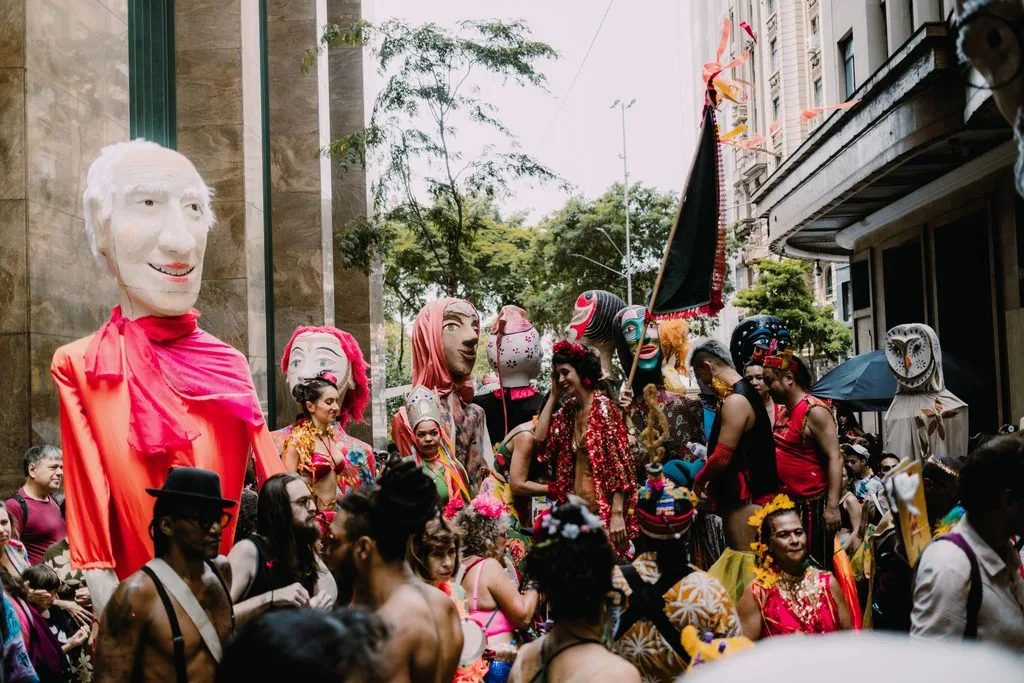
In Olinda, Carnival winds through the narrow streets of the historic center, with bands, dancers and the spectacular bonecos gigantes, huge satirical figures of celebrities or politicians carried through the streets in procession. You’ll do a lot of walking here, dancing and letting the crowd carry you along. The streets can get very crowded and very steep, so all you really need to enjoy it is a pair of comfy shoes and plenty of patience.
Who are Recife and Olinda for? Anyone who prefers a more traditional, local feel, folk music and a less touristy Carnival you mostly experience on foot.
São Paulo: The Party Alternative, Minus the Crowds of Tourists
São Paulo doesn’t usually spring to mind when people think of Carnival the way Rio does, but it hosts one of the biggest Carnivals in Brazil. Here too, the samba schools compete at the Sambódromo do Anhembi, with spectacular parades that traditionally take place on Friday and Saturday. São Paulo is also famous for its blocos de rua, which bring different neighborhoods to life with free concerts and parties. And the scale of the celebrations is truly huge: in 2026, there were more than 600 official blocos!
Who’s São Paulo for? Anyone who wants to combine the party with the culture and food scene of a big city, or who’s looking for something different from the classic Rio trip.
Sambadrome Tickets: How Much Do They Cost?
If you want to watch the samba school competition in Rio de Janeiro, there are a few ticket tiers to choose from. The cheapest seats are usually the arquibancadas (the bleachers), the frisas are boxes closer to the parade track, and the camarotes are premium areas with extra perks, at a higher price.
For 2027, these are the prices published on the official website for the most popular categories:
| Type | Approximate price for 2027* | In euros, approx.* |
|---|---|---|
| Special arquibancadas | R$250 per night | €40 |
| Discounted arquibancadas | R$125 per night | €20 |
| Frisas | R$1,835 to R$10,200 per night | €300 to €1,800 |
| Camarotes | From R$447 up to around R$5,400 | €400–€4,830 |
*Prices checked in October 2026. Euro conversions are approximate, based on an exchange rate of about 1 Brazilian real = €0.179 as of October 26, 2026. The actual rate applied by the payment provider may differ.
The arquibancadas are the cheapest option, but you’ll still get a great view of the parades, you’ll just be a bit higher up. The frisas are boxes closer to the track, perfect if you’re in a group of up to 6 people. The camarotes are private areas that vary depending on the organizer but come with more extras (think open bar, buffet and so on), so they can cost well over €4,000. Sales opened in August 2026 and, at the time of writing, some sectors are already sold out on Ticketmaster, the official ticketing platform. But don’t worry: you can still get tickets through agencies (always check they’re legit!) and hotels that resell them (with a markup, of course).
Phone and Internet During Carnival in Brazil: Maps, Blocos and Safety
Heading to Brazil soon and planning to rely on your home SIM’s roaming for internet? It could cost you a fortune (on average €0.23–€0.50 per MB!). You’ve got other options, though: you can take your chances with public Wi‑Fi, buy a local SIM or, the most popular choice these days, get a Quibity eSIM data plan for Brazil.
Quibity offers a range of plans for every type of use and trip length, all easy to buy in just a few clicks. You won’t even have to get off the couch: you can buy the plan you like best well before you leave for Carnival in Brazil (up to 180 days ahead) and activate the eSIM only once you land.
So what’s the real advantage? There’s no hunting for a store as soon as you land, no figuring out which plan to buy and no wasting time setting up a new physical SIM. Local prepaid SIMs may also require ID and registration, which you don’t need at all with an eSIM.
Google Maps, Getting Around and Finding Meeting Points
With a reliable data connection, you can do loads of essential things: check the route to your accommodation on Google Maps, make sense of the subway signs or look at maps while you hunt for a bloco. Another really handy tip we always give: download offline maps of the areas you’ll be visiting. They’re no full substitute for a connection, but they come in useful when the signal is weak, and they save data too. Want to keep a closer eye on your usage? Check out our guide to how much data Google Maps uses.
There are also several apps and websites that help Carnival-goers in Brazil find their way around the blocos during the festivities. Some come from the official organizers, others don’t, but they all let you search for events live and see where they are in real time:
- Rio Carnaval, created by LIESA (the official body that organizes the samba schools) to follow the parades at the Sapucaí
- Blocos de Rua, to follow the blocos and their routes in lots of cities across Brazil
- Mapa do Bloco, the website and app, also handy for planning and filtering the different experiences on offer during Carnival
The official programs usually list the Concentração time (when the band gets together and people start gathering) and the Saída time (when the bloco starts moving down the street). If you want to catch it from the start, keep an eye on the official sites and try to get there for the meeting time so you don’t miss it. During the festivities, lots of last-minute or “secret” blocos (actually called blocos secretos) only post their routes on their official Instagram pages or in Facebook groups, so you’ll need to dig a little deeper on social media.
If you’re traveling with friends, it’s always a good idea to agree on a meeting point in advance, in case the network gets congested or someone’s phone dies, so nobody gets lost in the crowd.
Your Safety Comes First
Carnival is a fantastic time to take photos and videos and post them on social media, but when things get really packed and the streets are heaving with people, it pays to keep a closer eye on your phone and other devices. During the 2026 edition, Rio police reported 458 arrests and 97 recovered phones as part of their Carnival operations. Those numbers refer to that specific edition and aren’t a reason to panic before you even get there, but they’re a good reminder, especially for tourists, of how important it is to take a few precautions. Here are the ones we came up with. They may seem obvious, but we think they’re the most useful:
- Only bring what you really need and leave your valuables somewhere safe, like your hotel
- Keep your phone in an inside pocket or a secure case, and avoid holding it in your hand all the time when you’re walking through the crowd
- Turn on your screen lock, your device’s location features and the options to erase or protect your data if it gets stolen
Having internet and a smartphone at hand is essential, but as always at events of this size and kind, it’s best to go easy on your phone. You’ll enjoy it more, too!
Vaccinations and Documents for Brazil
Before you leave for Carnival in Brazil, there’s the least fun but absolutely essential part of planning: checking your documents and any vaccinations you need for the areas you’ll be visiting.
Recommended Vaccinations: Where to Find Information
For health advice on Brazil, your best reference is your government’s official travel advice and the World Health Organization (WHO), which recommend yellow fever vaccination for some areas. So if you’re visiting places beyond the big cities, look into it well in advance and talk to your doctor too.
Passport and Visa: What You Need
Visa rules for Brazil depend on your nationality: citizens of many countries, including EU countries, don’t need a visa for tourist stays of up to 90 days, while others have to apply before they travel. Check the requirements for your passport on the official websites before you book. Either way, you’ll need a passport, and it must be valid for at least 180 days from the date you enter the country.
Planning Your Trip: A Practical Guide
Here are a few more practical tips that could make your trip:
Power Outlets and Voltage in Brazil
Brazil mainly uses type N outlets, but you’ll also find sockets that fit type C plugs (the ones with two round pins used by lots of European devices, to give you an idea).
The voltage isn’t the same across the whole country: in Rio de Janeiro, São Paulo and Salvador it’s usually 127 V, while in several other areas, especially in the Northeast, you may find 220 V.
Before you go, check the label on your phone charger and any other devices you want to bring. If it shows a range like 100–240 V, it’ll generally work with both voltages, and a plug adapter may be all you need. Keep in mind, though, that an adapter doesn’t convert voltage. A universal adapter is a good idea, especially if your itinerary covers several cities.
The Weather in Brazil: When to Go If You’re Not Traveling for Carnival
Brazil is huge, and the weather changes a lot from one region to the next. February is hot in many of the most famous Carnival destinations, but it’s summer, so expect high humidity and the odd downpour too.
If you’re planning a trip at another time of year, keep this in mind:
- Rio de Janeiro and the Southeast: pleasant all year round. If beaches are your top priority, December to March is the best time, but it’s also when you’ll get heat, humidity and more tourists
- The Northeast, including Salvador: August and September can be good months if you want it less hot and drier
- The Amazon: August and September are often considered the best time, but watch out for the rains, which are heaviest between December and May.
Extend Your Trip: Iguazú Falls, Between Brazil and Argentina
If you’d like to stretch your trip to 10–15 days, why not see a bit more than just Carnival? One of the most popular add-ons is Iguazú Falls, on the border between Brazil and Argentina. Extending your itinerary a little is a great idea if you want to balance the music and party chaos of Carnival with a few peaceful days surrounded by nature.

On the Brazilian side, Iguaçu National Park gives you a spectacular panoramic view of the falls, while on the Argentine side, Iguazú National Park winds through a network of jungle trails you really can’t miss.
The two main airports are Cataratas del Iguazú (IGR) on the Argentine side and Foz do Iguaçu Airport (IGU) on the Brazilian side, and crossing between the two by bus or taxi is very doable, taking about 30–40 minutes. If you want to add the falls as a stop after Carnival in Brazil, coming from one of the cities we’ve recommended, February is an ideal time: the water flow is at its peak (and so are the crowds, it has to be said), and the weather is pretty hot but bearable.
And if you’re planning to continue your trip in Argentina, you can stay connected with an Argentina eSIM, so you don’t miss a single day of connection on your trip.
FAQs
When does Brazil Carnival 2027 start and end?
The main Carnival days run from February 6 to 9, 2027, with Ash Wednesday on February 10. In Rio de Janeiro, the Grupo Especial parades at the Sambadrome will take place on February 7, 8 and 9.
Which is better, Rio Carnival or Salvador Carnival?
It all depends on the experience you’re after. Rio is famous for the spectacular samba school parades at the Sambadrome and its countless street blocos, so let’s say it’s better if you want a more organized show. Salvador is known for its trios elétricos, moving concerts and huge open-air parties, so it’s better if you want more of a “street” experience.
How can I get internet in Brazil during Carnival?
You can always use your carrier’s roaming (although it’s expensive), buy a local SIM or install an eSIM on your compatible smartphone. You can get a Quibity eSIM for Brazil ready well before you leave, so you won’t have to stress about finding a physical SIM when you arrive. Before you buy, check the coverage, supported networks, data allowance and plan length.