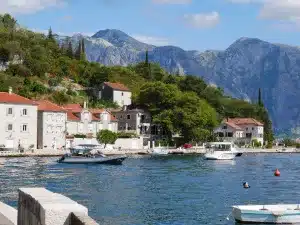
Montenegro’s coastline is surprisingly varied. The country may look small on the map, but Montenegro’s beaches are plentiful, and they change as you travel from north to south. The coast runs for about 300 kilometers, and each stretch has a character of its own. Around Budva you’ll find some of the busiest beaches with the most facilities. Head toward Ulcinj and the landscape opens up into vast stretches of sand. The Bay of Kotor, on the other hand, is famous above all for its views, its hidden coves and the little villages right on the water.
So where should you spend your beach vacation in Montenegro? Our first tip: don’t just go by the photos you see online. Let’s take a closer look together and find the beach that suits you, starting with the best-known part of the coast and working our way south.
The Budva Riviera: Mogren, Jaz and Bečići
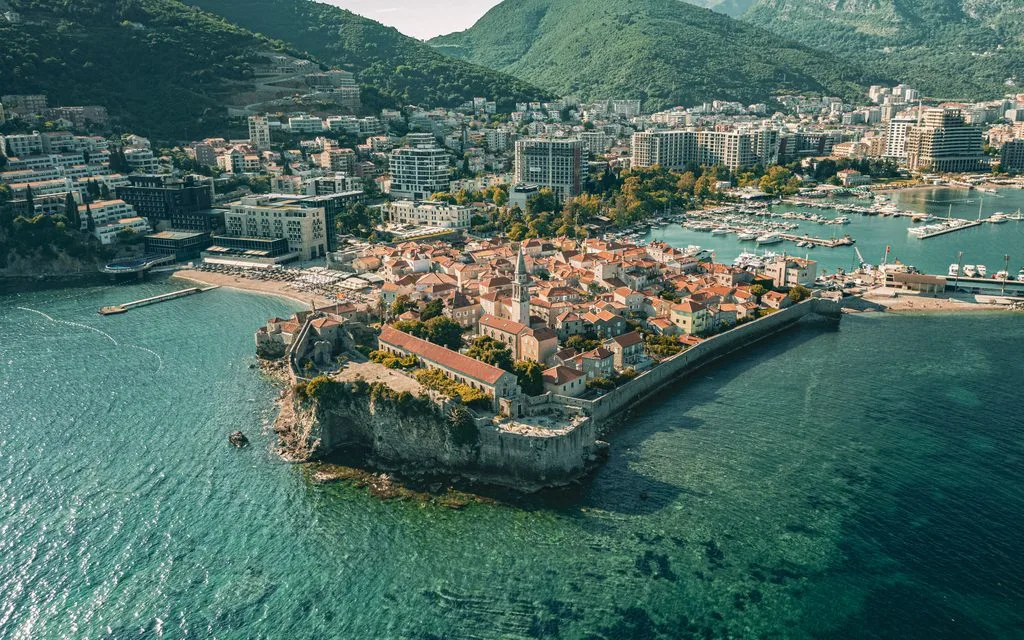
First time in Montenegro and want a bit of everything close at hand? Budva is probably one of the best seaside towns to start from. The Old Town, with its stone lanes, seafront restaurants and walls looking out over the Adriatic, is just a stone’s throw from the beach. If you’re traveling at the height of summer, say in July or August, and the thought of circling for hours looking for parking stresses you out, it’s worth considering one of the nearby towns too.
Mogren
Mogren is one of Budva’s best-known beaches. It’s just outside the center, and you can even walk there along a scenic coastal footpath. The beach is split into two small bays linked by a passage through the rock. The water is gorgeous, with a mix of sand and pebbles underfoot. It’s ideal for couples and for anyone staying in town who doesn’t want to travel far. It’s small, though, so get there in the morning: in high season it fills up fast.
Jaz
If Mogren feels a little too cozy, head to Jaz Beach, just a few kilometers from Budva. The scenery here is different: it’s a much wider bay, and the beach goes on and on, with more pebbles than sand. Some sections have sunbeds and beach clubs, while others are free for you to set up wherever you like. There’s also a campsite if you’re planning a road trip around Montenegro by car or camper van.
Slovenska plaža
Slovenska plaža is Budva’s town beach through and through. It runs along the seafront promenade, and it’s one of the most practical options if you’ve booked a place in the center.
Let’s be honest: it’s not necessarily the prettiest beach in the area, especially next to the natural bays of Mogren. But it has one big advantage: you don’t have to figure out how to get there.
Bečići
Looking for a convenient base for a beach vacation, without giving up on amenities? Bečići is one of the most appealing alternatives on the Budva Riviera. It’s great for families too. The beach is mostly sand, and compared with the smaller bays nearby, you’ll have a lot more room to spread out for the day. Bonus: every August it hosts the Sea Dance Festival, an electronic music festival right on the beach.
Sveti Stefan and Miločer
Carry on south from Budva for about ten kilometers and you’ll reach Sveti Stefan. You’ve probably already seen at least one photo of it. It’s one of Montenegro’s most famous views: a tiny islet joined to the mainland by a narrow strip of land and covered in its trademark red-roofed buildings.
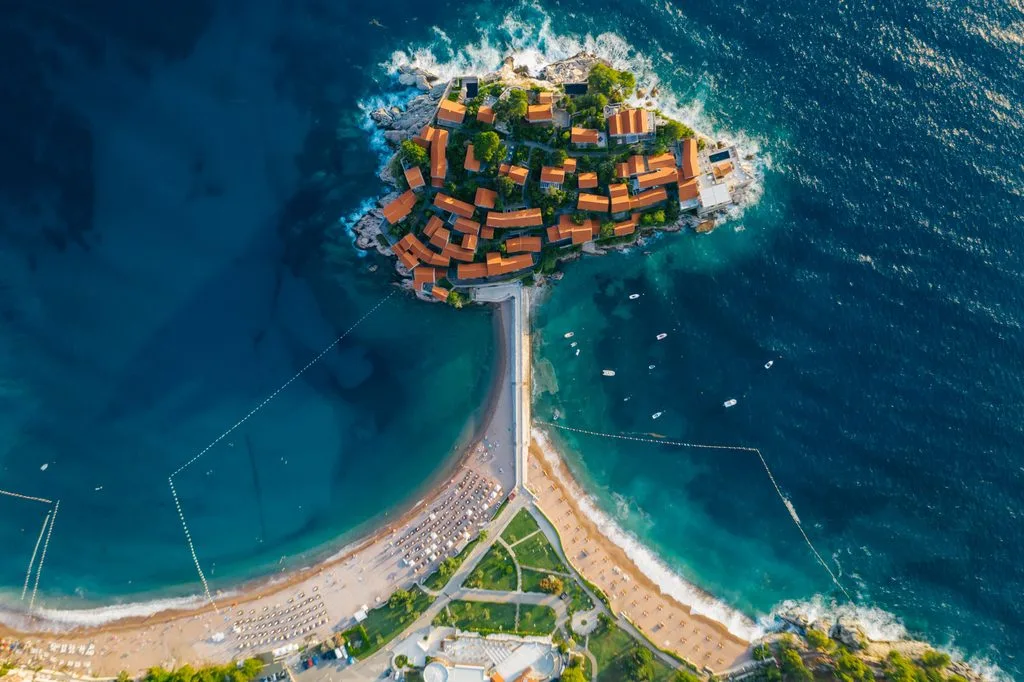
One thing to know: the island is home to a luxury resort, so unfortunately you can’t just wander around it like any other village. The beaches around it, though, are easy to reach and absolutely worth it.
Sveti Stefan beach is split into two areas, one north and one south of the isthmus. The public beach to the north has beautiful pinkish pebbles and a great view of the islet (the water gets deep fairly quickly, so be careful if you have kids with you). The southern beach is sandy, but it has always been tied to the resort we mentioned, so access can change depending on the season.
Just a few minutes away is Miločer, a leafy and very elegant area that’s home to one of the best-known beaches on the coast. The bay has pink-tinged sand and is surrounded by lush Mediterranean vegetation.
Petrovac and Lučice Bay
If Budva feels too hectic and Sveti Stefan too exclusive, Petrovac could be the happy medium you’re looking for. It’s a smaller, more laid-back town, and a good fit for a vacation that mixes beach days, walks and the odd excursion. Its location is ideal too, since you can easily walk to the beach.
If you’re after a more sheltered bay and a slightly wilder setting, though, head to Lučice Beach. This small bay is just south of Petrovac’s center, and you can get there on foot or by car. The walk is fairly short, but in the summer heat it can be a challenge. The water is crystal clear and the seabed slopes gently, so it’s good for kids too.
Ulcinj: Velika Plaža and Ada Bojana
Keep heading south and, almost at the Albanian border, you’ll find Ulcinj. It’s a distinctive town whose culture still bears the mark of centuries of Ottoman rule. It’s definitely cheaper than Budva and Kotor, and it’s the better choice if you want a few days at the beach without big beach clubs and tourist attractions.
Velika Plaža, also known as Long Beach, stretches for about 12 km and is the longest beach anywhere on the Adriatic. Unlike the bays around Budva, this is a wide, sandy shoreline that kitesurfers love, thanks to the strong wind that picks up in the afternoon.
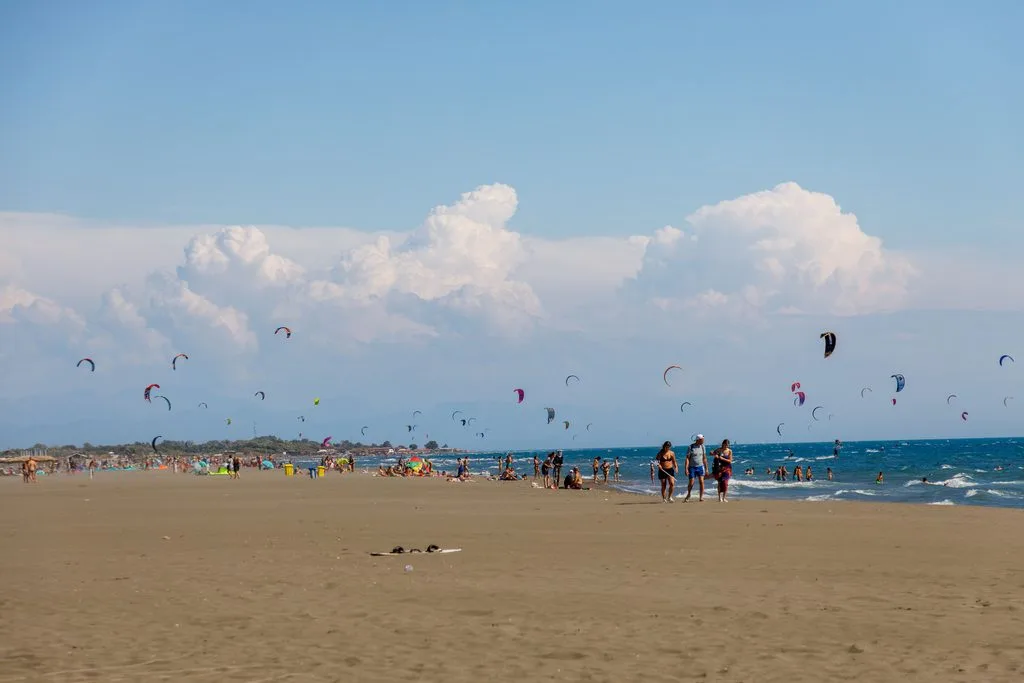
A little further south is Ada Bojana, a truly unique spot that’s worth a visit for the scenery alone, and even more so if you’re into water sports. It’s a river island at the mouth of the Bojana River, right by the Albanian border. For us, there’s one more reason to stay at least a day: the atmosphere. Along the river you’ll find restaurants and bars, often built on stilts, where you can stop for fresh fish with an incredible view.
The Bay of Kotor and the Luštica Peninsula
The Bay of Kotor is probably one of the most spectacular landscapes in Montenegro. Here the mountains seem to plunge straight into the sea, creating a series of inlets that look almost like a fjord.
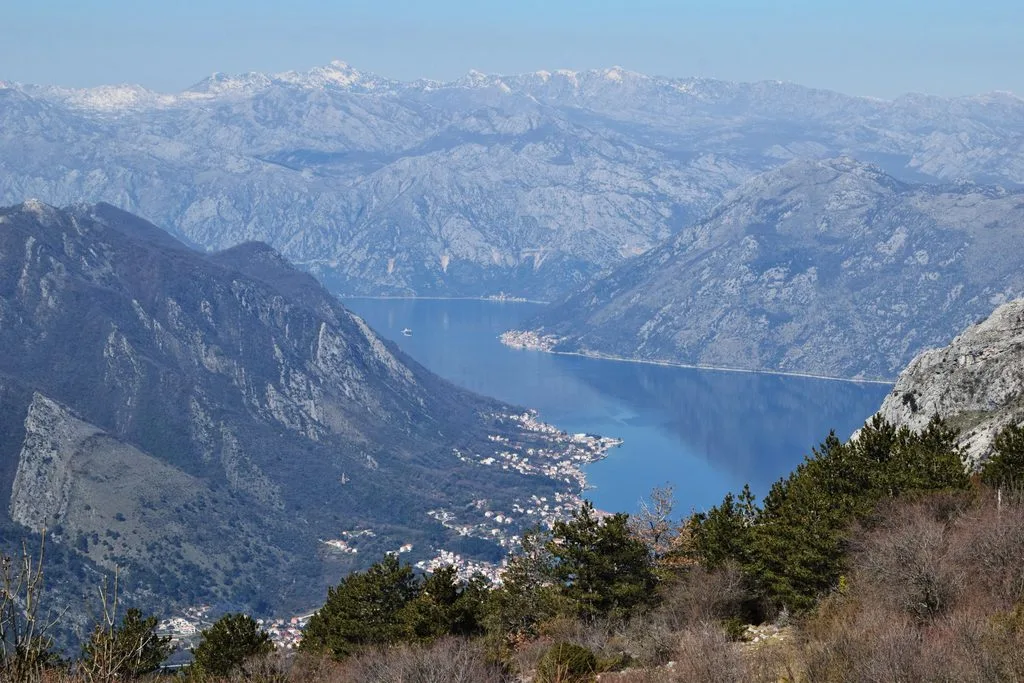
Along the bay you’ll mostly find small pebble coves, jetties and concrete platforms where you can get straight into the water. They’re perfect for a quick dip, maybe after exploring a town or two, but they’re not for you if you’d rather spend the day relaxing on a comfy sunbed.
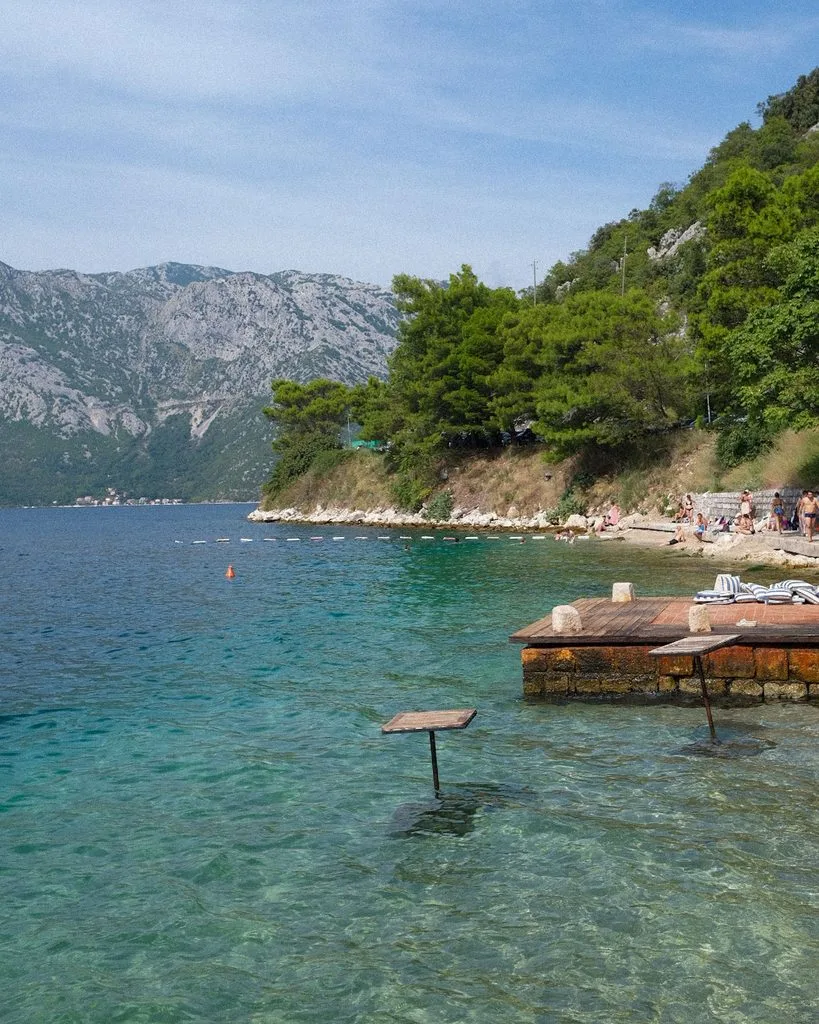
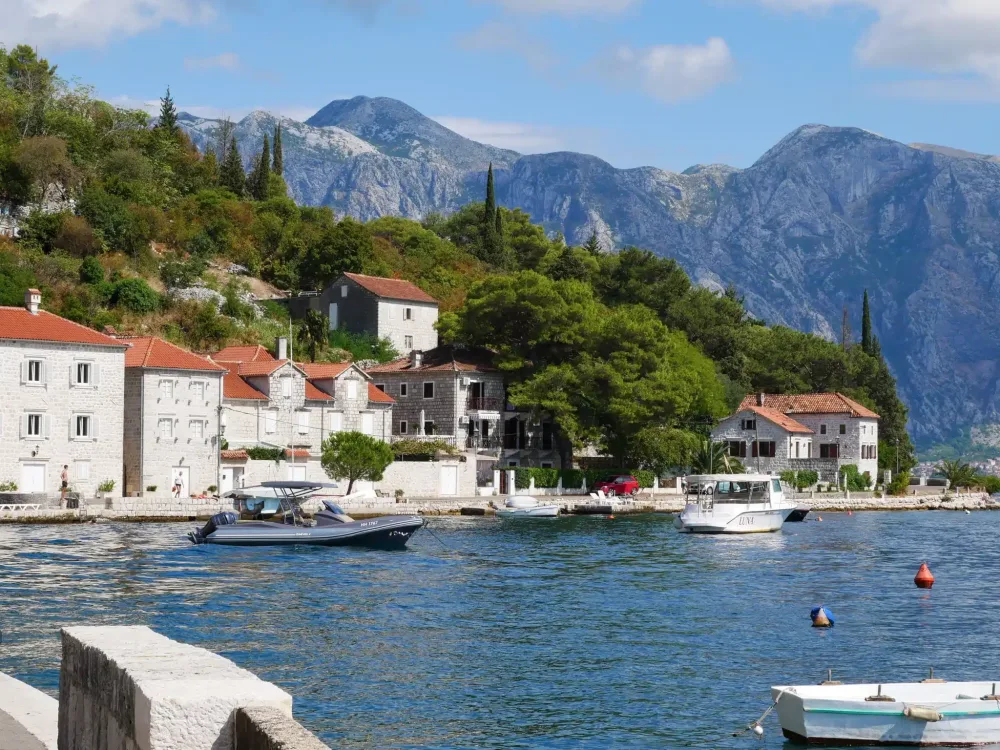
Perast is a good example. It’s one of the most photographed towns on the Bay of Kotor, with historic palaces, churches and a gorgeous waterfront. Just don’t expect a big beach: here you mostly swim from the platforms and the access points along the promenade.
Bar and Sutomore
Further south still is Bar, one of Montenegro’s most important port cities and a handy starting point for exploring the beaches of the southern coast. Fun fact: Bar is the sunniest city in Montenegro (around 270 days of sunshine a year!), so in theory you could enjoy its beaches all year round. It has plenty of scenic swimming spots and, as its name suggests, a lively nightlife too.
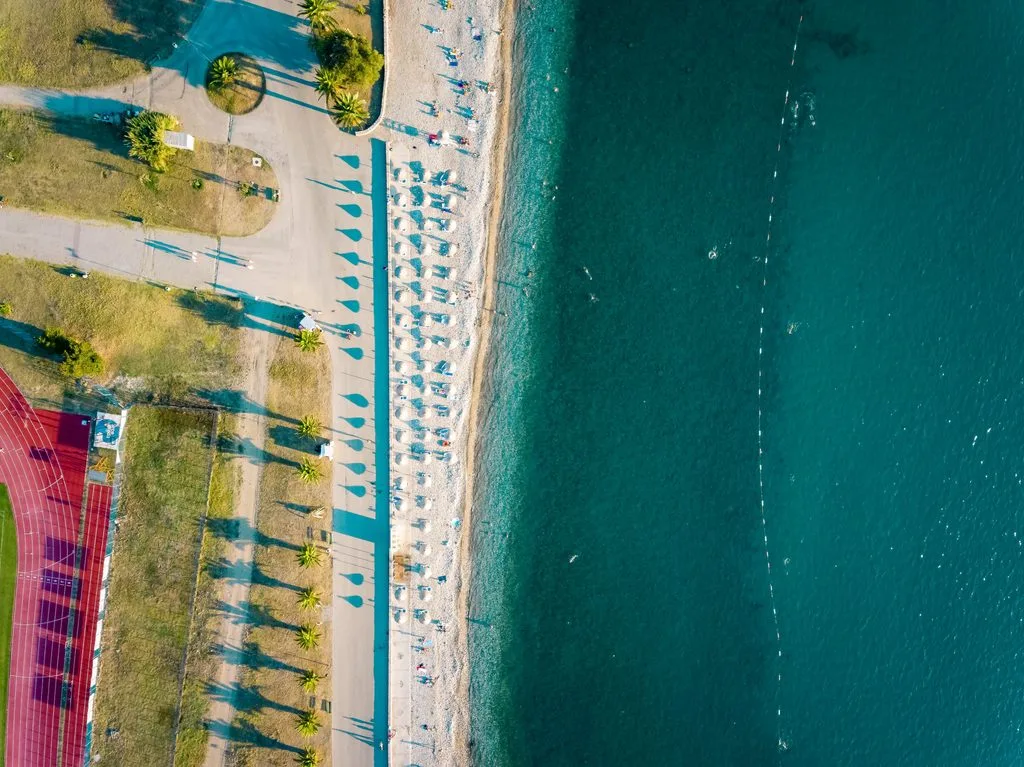
Not far away is Sutomore, one of the most popular summer spots with Montenegrin vacationers. The flip side is the crowds: in July and August the beach can get very busy. It’s still worth it, though, because there’s something for every budget, and it’s easily the most affordable and lively spot on the Riviera.
Which beach to choose: surface, facilities and traveler type at a glance
In Montenegro, not every beach works the same way. Some are an easy walk away, others need a car, and some you can only reach by boat. What’s underfoot varies a lot too, from fine sand to pebbles to the concrete platforms of the Bay of Kotor.
Here are the key features of every beach we’ve covered so far, so you can compare them at a glance before you choose:
| Beach | Area | Surface | How to get there | Access & facilities | Best for |
|---|---|---|---|---|---|
| Mogren | Budva | Sand and pebbles | On foot from the center, along the coastal path | Sunbed areas and free sections, depending on the season | Couples |
| Jaz | Budva | Mostly pebbles | Car or local transport | Beach clubs, free sections and a campsite nearby | Groups and active travelers |
| Slovenska plaža | Budva | Pebbles | On foot from the center | Bars, restaurants and beach clubs | Nightlife lovers |
| Bečići | Budva | Sand and fine pebbles | On foot or by car | Fully equipped beach with amenities | Families |
| Sveti Stefan, north side | Sveti Stefan | Pinkish pebbles | On foot, via access paths and steps from the road | Public beach and paid sunbeds | Couples |
| Sveti Stefan, south side | Sveti Stefan | Sand and pebbles | On foot | Always check access conditions first | Resort guests and visitors |
| Miločer | Miločer | Fine pink sand | On foot | Access and prices depend on the beach operator | Couples and luxury travelers |
| Main beach | Petrovac | Pebbles | On foot from the center | Beach clubs and restaurants | Families and couples |
| Lučice | Petrovac | Sand and fine pebbles | On foot or by car | Sunbeds and beach services | Families |
| Velika Plaža | Ulcinj | Dark sand | Car or local transport | Long stretches of free beach and beach clubs | Families and kitesurfers |
| Ada Bojana | Ulcinj | Sand | Car | Bars, water sports and a naturist area | Kitesurfing and relaxing |
| Žanjic | Luštica | White pebbles | Car or boat | Beach clubs and boat trip departures | Couples and day-trippers |
| Perast | Bay of Kotor | Concrete platforms | On foot from the center | Water access along the waterfront | Exploring the old towns |
| Bar beaches | Bar | Sand and mixed stretches | On foot or by car, depending on the spot | Free and equipped beaches | Families |
| Sutomore | Sutomore | Sand | On foot from the center | Bars, restaurants and beach clubs | Groups and families |
If we had to choose by type of vacation, Bečići, Lučice and Plavi Horizonti are among the most family-friendly options. If sand and space are your top priorities, look to Velika Plaža. And if you’d rather have a scenic beach close to a lively town, Mogren or Slovenska plaža are the way to go.
When to visit Montenegro for a beach vacation
May: ideal for exploring towns like Budva and Kotor, going for walks and even taking the odd dip. The sea is still cool (18–19 °C), and some services may not be open yet.
June: one of the best months of all. The sea is 21–23 °C, the beaches are less crowded and accommodation is generally cheaper.
July and August: perfect for a beach-only vacation, with water at 25–26 °C, but also the busiest and most expensive months. Watch out for traffic and parking.
September: the time to go if you want a quieter vacation. The sea is still warm (23–24 °C), there are fewer tourists and prices are lower.
October: you can still hit the beach, especially early in the month, but the weather is less predictable. Ideal for seeing towns and landscapes without the summer crowds.
Our top picks: June or early September.
How much does it cost? Sunbeds, umbrellas and average prices
Montenegro can still be good value for a standard beach vacation, but prices vary a lot depending on where and when you go. A public beach in Ulcinj obviously costs a lot less than an exclusive beach club near Sveti Stefan.
Here’s roughly what sunbeds and umbrellas cost in summer 2026:
Ulcinj: €12–20 for two sunbeds and an umbrella.
Budva and Bečići: usually €15–25, though some beaches charge as much as €50.
Miločer and exclusive beaches: up to €200–240 for a premium spot with two sunbeds, an umbrella and service.
Accommodation: in high season, an apartment in Budva can cost around €75–80 a night, while in Kotor it’s about €85. For a 3- or 4-star hotel, budget roughly €90–180 a night, depending on location and amenities.
Restaurants: a pizza costs €8–15 on average, while a seafood dinner for two with wine can easily run €60–100. At the more touristy restaurants, especially on the seafront, the bill can be higher.
How to get to Montenegro from Italy: ferry or plane
Getting to Montenegro takes a bit of planning, especially if you want to make a road trip of it. You can also get there by ferry or by plane, though, depending on the kind of trip you have in mind.
By plane: the main airports are Podgorica and Tivat. Podgorica is handy for visiting the capital and the interior, while Tivat is closer to Kotor, Budva and the Bay of Kotor. Flights from Italy, including with airlines like Wizz Air, vary by season.
By car: a good option if you want to plan a road trip through Croatia, Montenegro and Albania, or visit several beaches and towns. Keep in mind that Montenegrin roads can be winding, and in summer traffic gets a lot heavier around Budva, Kotor and Sveti Stefan.
Internet in Montenegro: why roaming isn’t included
When you’re planning a trip abroad, flights, accommodation and documents usually top the list. But there’s one easily overlooked detail that can make a real dent in your budget, and make getting around a lot harder: your internet connection.
With Montenegro, it pays to do your homework before you go. The country uses the euro, but it isn’t part of the European Union, and the two are easy to mix up. Using the euro doesn’t mean Montenegro automatically follows every EU rule, and that includes the roaming rules, which let you use your phone plan in participating countries at no extra cost, within the terms of your contract.
In other words, if you land in Montenegro with an EU SIM and turn on mobile data, your carrier will charge you its non-EU rates (€0.45 per MB on average). Curious why some countries come with extra charges when you use your phone abroad? Take a look at our guide on how data roaming works and how to avoid sky-high charges.
Will Montenegro ever join free EU roaming?
That could change in the next few years.
On February 25, 2026, the European Commission proposed opening negotiations to extend Roam Like at Home to the six Western Balkan countries: Albania, Bosnia and Herzegovina, Kosovo, Montenegro, North Macedonia and Serbia. The next step came on June 4, 2026, when the Council of the European Union officially authorized the start of negotiations.
It’s big news if you travel to the Balkans often, but it doesn’t mean free roaming is already here. Montenegro’s regulator, EKIP, has pointed to late 2026 or early 2027 as a possible timeline. That’s a forecast, though, not an official launch date.
So if you’re planning a vacation for next summer, don’t assume you’ll be able to use your Italian SIM at no extra cost just yet. Before you leave, always check for updates from the European Commission on the Western Balkans roaming negotiations and on the EU Council decision of June 4, 2026.
In the meantime: get sorted with a Quibity eSIM
If you don’t want to risk a huge phone bill, you can buy an eSIM before you leave.
It couldn’t be easier. Instead of hunting down a store for a physical SIM once you land in Montenegro, you install a digital profile on your phone by scanning a QR code before you go, without even getting off the couch.
With Quibity’s eSIM Montenegro, you can sort out your connection for the whole trip and use the country’s local networks, including M:tel and T-Mobile. It really comes in handy if you plan to move around a lot along the coast. Picture this: you set off from Budva, drive to a beach on the Luštica Peninsula and then go looking for a restaurant in Kotor. With internet on hand, you can check maps, pull up your bookings and plan your next move, no frantic search for Wi‑Fi required.
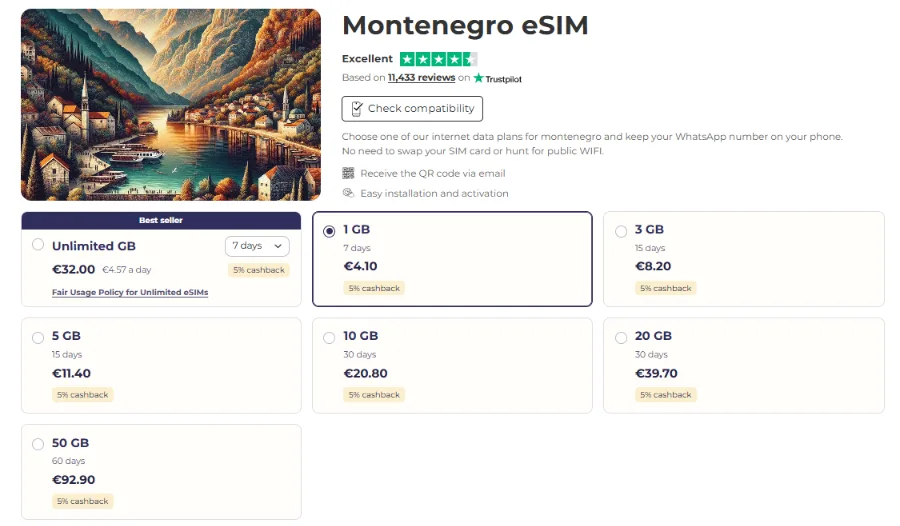
You can keep your SIM in your phone for calls and texts, and set the eSIM as your mobile data line, which activates the plan you bought.
Extending your trip: Croatia, Albania and a Balkans tour
Thanks to its location, Montenegro makes a perfect stop on a Balkans road trip. It’s easy to pair with its neighbors, especially if you have at least a week.
Montenegro and Croatia: start in Dubrovnik, cross the border and explore the Bay of Kotor, Kotor, Budva and Sveti Stefan. It’s an ideal trip if you want a mix of towns, bays and beaches.
Montenegro and Albania: from Ulcinj you can carry on to Shkodër, Tirana and the Albanian coast, and discover places like Vlora, Himara and Saranda. You’ll find more must-see spots in Albania in our dedicated guide.
Balkans tour: with 10–14 days, you can combine Croatia, Montenegro, Albania and Bosnia and Herzegovina, with stops in Montenegro’s interior like Lake Skadar and Durmitor National Park. Not sure where to start? Here’s how to plan the perfect trip to the Balkans.
Before you go, allow extra time for border crossings, which can take longer in summer, and check your car insurance coverage in each country. And remember: if you’re traveling through several countries, a single eSIM that covers the Balkan countries on your route, like Quibity’s Balkans eSIM, is a practical way to stay connected without switching SIMs at every border.
FAQs
What are the best sandy beaches in Montenegro?
If you’re looking for sandy beaches, the best areas to consider are Ulcinj, Petrovac, Bečići and the Luštica Peninsula.
Velika Plaža, in Ulcinj, is probably the most unique: it stretches for about 12 kilometers, with dark sand and long stretches of free beach. If you’d prefer a more secluded bay, go for Lučice in Petrovac or Plavi Horizonti on the Luštica Peninsula. Bečići is a good choice if you want a big beach with plenty of amenities nearby.
When is the best time for a beach vacation in Montenegro?
June and the first half of September are generally the nicest, most balanced times to go. In June the sea is already pleasant for swimming and the beaches are still fairly quiet. In September, the water holds on to the summer warmth and there are fewer tourists than in August.
If you want the warmest sea possible, July and August are your best bet, but expect more tourists, more traffic and, of course, higher prices.